Fifteen Medicare Advantage plans earned five stars for 2027, down from 22 last year, and 188 of 508 rated contracts landed at four stars or higher (Becker’s Payer). CMS released the ratings on October 8, a week before open enrollment starts. Four stars is supposed to mean bonus money, and bonus money is not the same thing as margin.
Does a 4-star Medicare Advantage rating guarantee higher margin?
No. A 4-star rating unlocks a quality bonus on Medicare payments, and a bonus is a revenue line. KFF says Medicare will spend more than $13 billion on the program in 2026 (KFF).
Most of the market is already there. Nearly 24 million people, or 68% of enrollees, sit in plans that qualify for the bonus in 2026 (KFF), and CMS says about 71% are in contracts with four or more stars for 2027 (Fierce Healthcare). When most of your competitors earn the same bonus, it stops being an edge and becomes table stakes.
Plans can also spend the bonus right back. Reporting on Humana’s rebound noted a potential $4.8 billion bonus in 2028, with the earnings benefit depending on reinvestment decisions (Beinsure).
What is actually happening here?
The ratings are getting harder to hold. The enrollment-weighted average rating slipped to 3.99 from 4.01, and the share of contracts at four stars or higher fell to 37% from about 44% (Becker’s Payer). Fewer contracts qualify, but they hold more members.
The swings by company are huge. Humana says 95% of its members will be in four-star-plus plans for 2027, up from 20% in 2026 (Beinsure). Clover Health went from 3% to 100% by Stephens’ count, while UnitedHealthcare slipped to about 67% from 78% (Fierce Healthcare).
The rules keep moving too. CMS deleted 11 measures from the 2027 calculations (Fierce Healthcare), and Healthcare Finance News reports the bigger overhaul takes effect in the 2028 ratings (Healthcare Finance News).
What are the experts saying?
Jeannie Fuglesten Biniek is associate director of KFF’s Program on Medicare Policy. She told Fortune that with higher payments, plans “can potentially provide extra benefits” (Fortune). She also noted that five-star plans do not get a bigger bonus than 4.5-star plans, so insurers see little reason to chase the fifth star.
Pam Price, a managing director at AArete, told Healthcare Finance News she did not expect big changes this year, because CMS keeps raising the bar (Healthcare Finance News).
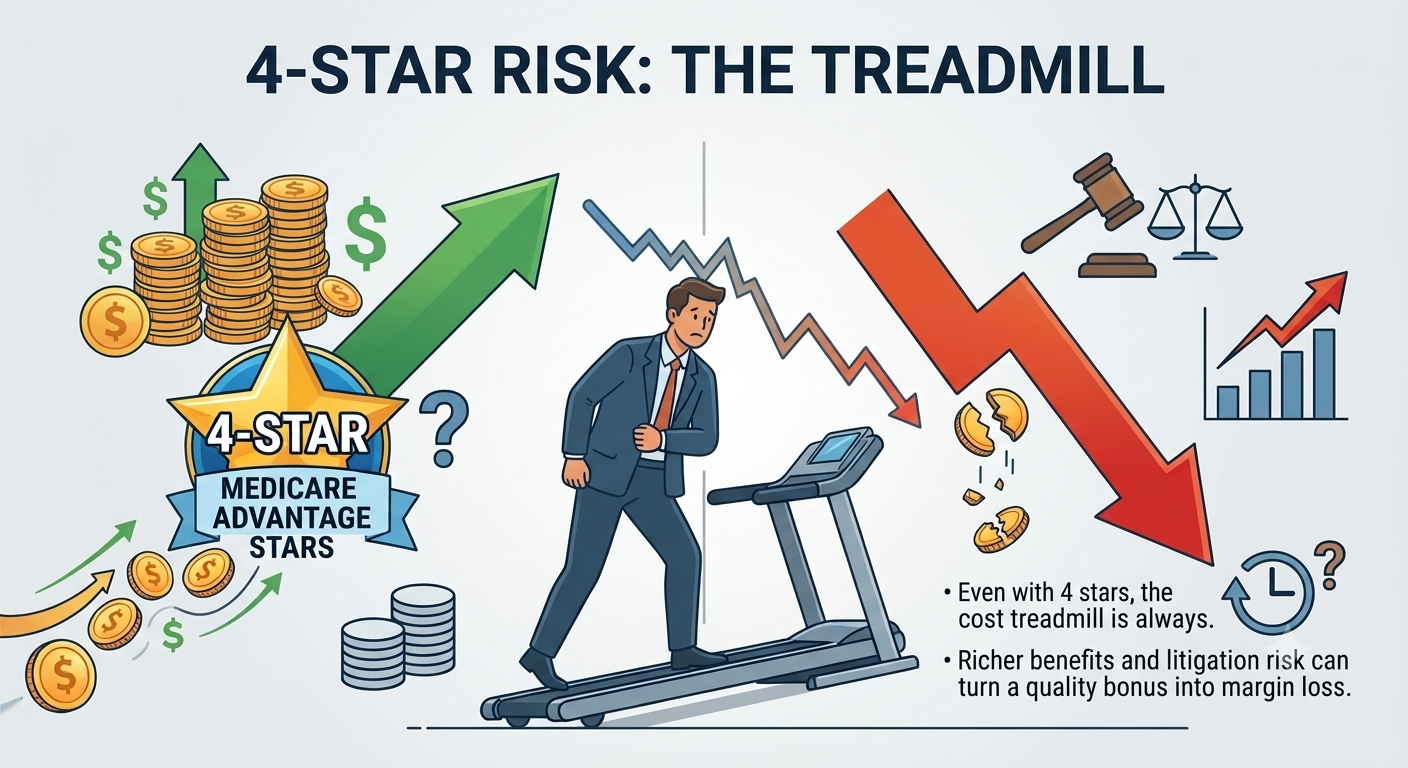
My take is that both comments point at the same trap. If the bonus funds richer benefits and the bar keeps rising, a plan can run harder every year just to stay in place. That is not a margin story, it is a treadmill story.
The part most articles skip
Four stars is rented, not owned. Humana saw its share of members in four-star-plus plans fall from 94% to 25% in the ratings for 2025, and Leerink estimated a $1.9 billion hit to 2026 revenue before any offsets (ABC News). It is back to 95% for 2027, which shows how fast the ground can shift.
Courts can rewrite a rating. After Clover Health won its lawsuit, CMS voluntarily recalculated 2027 quality bonus ratings for other contracts and removed several measures in the review (Becker’s Payer). CMS appealed that ruling in July (Fierce Healthcare), and Alignment Healthcare has already threatened to sue over its own downgrade (STAT).
One detail in the data gets ignored. Nonprofit insurers were more likely to reach four stars, 44% versus 34% for for-profit plans, yet 14 of the 15 five-star contracts belong to for-profit carriers (Becker’s Payer). The average hides two different games.
A quick number that matters
2.3% of projected 2026 Medicare Advantage payments, or $574 billion in total, is the share going to the quality bonus program. (KFF)
What does this mean for Medicare Advantage finance and strategy teams?
Open enrollment runs October 15 through December 7, and the 2027 ratings feed 2028 bonus payments (CMS). The planning job is already live.
- Split bonus revenue from margin in your model. Track the bonus dollars, the benefits they fund and what is left over.
- Stress test 2028 for one large contract losing half a star. Humana’s largest contract, H5216, moved from 3.5 to 4 stars this year, and that single move put it back above the bonus threshold (Stocktwits).
- Watch the litigation docket. Analysts at Capstone expect plans with material rating losses to litigate under the Clover standard (Fierce Healthcare).
- Build for the 2028 measure overhaul now, and do not assume 2027’s weights will hold.
- If you are a provider group in a risk contract, ask your plan partners which measures drive their stars. Those are the measures that will show up as data requests and gap lists.
Keep an eye on the lag. The ratings published this month shape payments in 2028, and they were built on 2025 measures with 2026 as the reporting year (Healthcare Finance News). A plan that waits for the stars to tell it how it did is reading a two-year-old report card.
Then ask your CFO one blunt question. If the bonus vanished tomorrow, which benefits would you cut first? The answer tells you whether the stars are paying for margin or just for membership.
The stars measure last year’s quality and pay next year’s bills. Which side of that gap is your plan actually managing?
Leave a Reply