Category: Health

  • Medicare Advantage Stars: Why a 4-Star Plan Can Lose Margin

    Medicare Advantage Stars: Why a 4-Star Plan Can Lose Margin

    Fifteen Medicare Advantage plans earned five stars for 2027, down from 22 last year, and 188 of 508 rated contracts landed at four stars or higher (Becker’s Payer). CMS released the ratings on October 8, a week before open enrollment starts. Four stars is supposed to mean bonus money, and bonus money is not the same thing as margin.

    Does a 4-star Medicare Advantage rating guarantee higher margin?

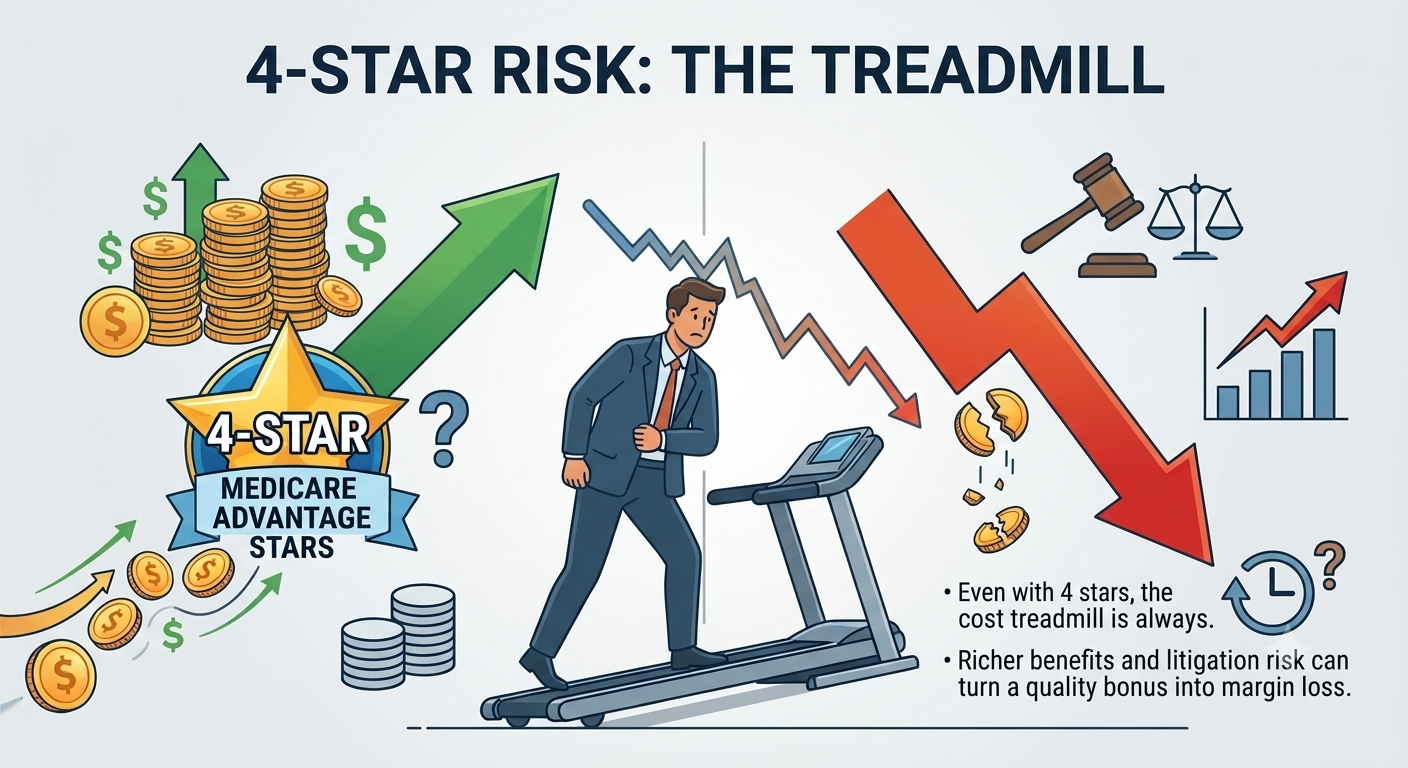
    No. A 4-star rating unlocks a quality bonus on Medicare payments, and a bonus is a revenue line. KFF says Medicare will spend more than $13 billion on the program in 2026 (KFF).

    Most of the market is already there. Nearly 24 million people, or 68% of enrollees, sit in plans that qualify for the bonus in 2026 (KFF), and CMS says about 71% are in contracts with four or more stars for 2027 (Fierce Healthcare). When most of your competitors earn the same bonus, it stops being an edge and becomes table stakes.

    Plans can also spend the bonus right back. Reporting on Humana’s rebound noted a potential $4.8 billion bonus in 2028, with the earnings benefit depending on reinvestment decisions (Beinsure).

    What is actually happening here?

    The ratings are getting harder to hold. The enrollment-weighted average rating slipped to 3.99 from 4.01, and the share of contracts at four stars or higher fell to 37% from about 44% (Becker’s Payer). Fewer contracts qualify, but they hold more members.

    The swings by company are huge. Humana says 95% of its members will be in four-star-plus plans for 2027, up from 20% in 2026 (Beinsure). Clover Health went from 3% to 100% by Stephens’ count, while UnitedHealthcare slipped to about 67% from 78% (Fierce Healthcare).

    The rules keep moving too. CMS deleted 11 measures from the 2027 calculations (Fierce Healthcare), and Healthcare Finance News reports the bigger overhaul takes effect in the 2028 ratings (Healthcare Finance News).

    What are the experts saying?

    Jeannie Fuglesten Biniek is associate director of KFF’s Program on Medicare Policy. She told Fortune that with higher payments, plans “can potentially provide extra benefits” (Fortune). She also noted that five-star plans do not get a bigger bonus than 4.5-star plans, so insurers see little reason to chase the fifth star.

    Pam Price, a managing director at AArete, told Healthcare Finance News she did not expect big changes this year, because CMS keeps raising the bar (Healthcare Finance News).

    My take is that both comments point at the same trap. If the bonus funds richer benefits and the bar keeps rising, a plan can run harder every year just to stay in place. That is not a margin story, it is a treadmill story.

    The part most articles skip

    Four stars is rented, not owned. Humana saw its share of members in four-star-plus plans fall from 94% to 25% in the ratings for 2025, and Leerink estimated a $1.9 billion hit to 2026 revenue before any offsets (ABC News). It is back to 95% for 2027, which shows how fast the ground can shift.

    Courts can rewrite a rating. After Clover Health won its lawsuit, CMS voluntarily recalculated 2027 quality bonus ratings for other contracts and removed several measures in the review (Becker’s Payer). CMS appealed that ruling in July (Fierce Healthcare), and Alignment Healthcare has already threatened to sue over its own downgrade (STAT).

    One detail in the data gets ignored. Nonprofit insurers were more likely to reach four stars, 44% versus 34% for for-profit plans, yet 14 of the 15 five-star contracts belong to for-profit carriers (Becker’s Payer). The average hides two different games.

    A quick number that matters

    2.3% of projected 2026 Medicare Advantage payments, or $574 billion in total, is the share going to the quality bonus program. (KFF)

    What does this mean for Medicare Advantage finance and strategy teams?

    Open enrollment runs October 15 through December 7, and the 2027 ratings feed 2028 bonus payments (CMS). The planning job is already live.

    1. Split bonus revenue from margin in your model. Track the bonus dollars, the benefits they fund and what is left over.
    2. Stress test 2028 for one large contract losing half a star. Humana’s largest contract, H5216, moved from 3.5 to 4 stars this year, and that single move put it back above the bonus threshold (Stocktwits).
    3. Watch the litigation docket. Analysts at Capstone expect plans with material rating losses to litigate under the Clover standard (Fierce Healthcare).
    4. Build for the 2028 measure overhaul now, and do not assume 2027’s weights will hold.
    5. If you are a provider group in a risk contract, ask your plan partners which measures drive their stars. Those are the measures that will show up as data requests and gap lists.

    Keep an eye on the lag. The ratings published this month shape payments in 2028, and they were built on 2025 measures with 2026 as the reporting year (Healthcare Finance News). A plan that waits for the stars to tell it how it did is reading a two-year-old report card.

    Then ask your CFO one blunt question. If the bonus vanished tomorrow, which benefits would you cut first? The answer tells you whether the stars are paying for margin or just for membership.

    The stars measure last year’s quality and pay next year’s bills. Which side of that gap is your plan actually managing?

  • Nurse Burnout Isn’t a Wellness Issue: The Staffing Math Says

    Nurse Burnout Isn’t a Wellness Issue: The Staffing Math Says

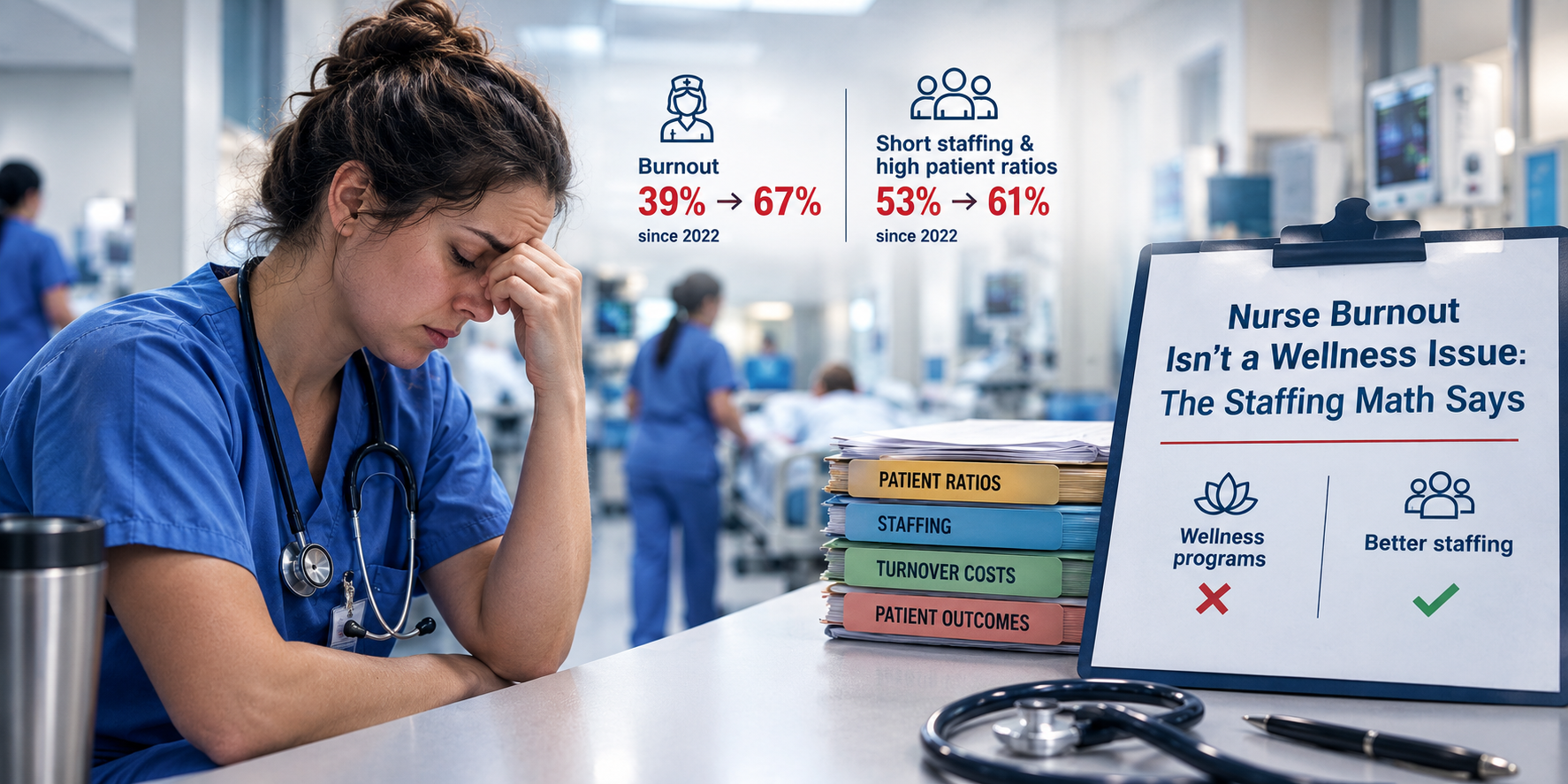
    Nurse burnout has climbed from 39% to 67% since 2022, according to a survey of more than 2,000 nurses and nursing students from Cross Country Healthcare and Florida Atlantic University (Florida Atlantic University). In the same survey, short staffing and high patient ratios rose from 53% to 61%. Hospitals keep answering with wellness programs, and the math says that is the wrong lever.

    Is nurse burnout a wellness problem or a staffing problem?

    It is mostly a staffing problem, and the evidence is old and steady. In a JAMA study of 168 Pennsylvania hospitals, every extra patient on a nurse’s load raised the odds of burnout by 23% and the odds of job dissatisfaction by 15% (JAMA). The same study tied each added patient to a 7% rise in 30-day surgical mortality.

    Think about what that means. One dial moves patient risk and nurse burnout at the same time. A meditation room does not touch either one.

    Scale it up, and the gap gets wider. Researchers estimated that a nationwide 8-to-1 ratio, compared with 4-to-1, would mean a 31% higher mortality rate, or about 20,000 additional deaths (California Healthline).

    What is actually happening here?

    Nurses are leaving at a rate hospitals can count in dollars. The 2026 NSI retention report found staff RN turnover hit 17.6% in 2025, up 1.2 points, and each lost bedside RN cost $60,090 on average (Becker’s Hospital Review). That adds up to about $5.19 million a year for the average hospital.

    Burnout is the pipeline into those exits. In the 2002 study, nurses with both high burnout and dissatisfaction were far more likely to plan to leave within a year, 43% compared with 11% for nurses without them (NIH NINR). Burned-out nurses are already halfway out the door.

    Not every unit bleeds the same. NSI found behavioral health at 22.5% turnover, emergency at 20.7%, telemetry at 19.5%, and step-down at 19%, all above the national average (Becker’s Hospital Review).

    What are the experts saying?

    Linda Aiken is the founding director of the Center for Health Outcomes and Policy Research at the University of Pennsylvania School of Nursing. She led a study published in JAMA Network Open in November 2025 and called investing in nurses a “two-for-one” solution, because it helps nurse and physician well-being while also strengthening patient care (HealthDay via MedicineNet).

    The data behind that line is striking. In U.S. hospitals, a 10% improvement in the nurse work environment, which included added staffing, was tied to a 10% drop in high burnout among doctors (HealthDay via MedicineNet).

    Here’s my take. We run physician wellness and nurse wellness as separate programs with separate budgets. One staffing decision moved both groups, and that should bother anyone who signs off on those budgets.

    The part most articles skip

    The fight is not about whether staffing works. It is about who sets the number. The American Nurses Association backs minimum ratios set by nurse-centered committees, while the American Organization for Nursing Leadership says leaders, managers and bedside nurses should align staffing, not policymakers (AACN).

    Skeptics say the research is just correlation. Queensland ran something closer to an experiment, phasing in minimum ratios in two stages, and the first-phase hospitals saw bigger drops in mortality, readmissions and length of stay than hospitals still waiting (AHCJ). Hospitals counter that mandates cut flexibility and raise prices, though some analyses suggest added staffing largely pays for itself, and Aiken’s New York work estimated a 4-to-1 ratio would have avoided more than 4,370 deaths and saved at least $720 million over two years among Medicare patients alone (Healthcare Finance News).

    The budget system hides the savings. AACN points out that hospitals book nurses as a cost without a matching revenue line, so staffing looks like pure expense even when the New York estimate counted savings from shorter stays and fewer readmissions (AACN). That is how a program that pays for itself keeps losing the budget fight.

    A quick number that matters

    $60,090 is the average cost of replacing one bedside RN. (NSI)

    What does this mean for nurse leaders and hospital finance teams?

    Move staffing out of the wellness bucket and into the retention bucket. Then do the math with your own numbers.

    Here is an illustration. Say you employ 400 RNs. At the national 17.6% turnover rate, about 70 leave in a year, and at $60,090 each that is roughly $4.2 million. If better staffing cut turnover by three points, 12 fewer nurses would leave and you would keep about $721,000 (NSI).

    1. Pull turnover by unit, not hospital-wide. The hot spots hide inside the average.
    2. Multiply exits by $60,090 to set your baseline cost of churn.
    3. Map patients per nurse by shift on your worst units. Remember the JAMA link of 23% higher burnout odds for each added patient.
    4. Price a one-patient reduction on those units against your baseline. Count the overtime and agency spend you would stop paying.
    5. Present it as retention savings. NSI estimates each one-point change in RN turnover moves the average hospital by $295,000 a year (Becker’s Hospital Review).
    6. Keep your wellness programs, but stop counting them as the staffing fix.

    Watch the gap between your numbers and the best performers. Magnet-recognized hospitals reported a 7.3% RN vacancy rate against 8.6% nationally in the NSI data (Nurse.org). If your vacancy rate sits above the national figure, your staffing plan is the first place to look.

    A burned-out nurse is a nurse counting the days. Which of your units is counting the days fastest?

  • Why Hospital Margins Slip When Medicaid Rules Change Midyear

    Why Hospital Margins Slip When Medicaid Rules Change Midyear

    Hospital operating margins fell 5% year over year through May, according to Kaufman Hall’s national flash report (Becker’s Hospital Review). Then CMS published the Medicaid work requirement rule on June 1, skipping the usual proposed version and leaving hospitals a thin window to respond (Becker’s Hospital Review). Most budgets were already locked.

    Why do hospital margins drop when Medicaid rules change midyear?

    The short answer is that revenue leaves faster than cost does. A patient who loses Medicaid still needs care, but the payment for that care is gone. The Commonwealth Fund’s hospital model assumes costs fall about 44% when a patient moves from insured to uncompensated care, which helps, but costs still fall by less than the payment does (Commonwealth Fund).

    Timing makes it worse. Nebraska started enforcing work requirements in May, Montana was set to follow in July, and every other state has to be running by January 1, 2027 (Becker’s Hospital Review). Hospital budgets run on annual cycles, and these rules do not.

    What is actually happening here?

    Congress wrote the work requirement into HR 1. Adults ages 19 to 64 in expansion coverage must show 80 hours a month of work, school or community service to keep Medicaid. CMS then used an interim final rule, which means the normal proposal and comment round never happened first (Becker’s Hospital Review).

    The money picture was already soft. By June, Kaufman Hall’s year-to-date operating margin index sat at 2.5%, down 6% from the first half of 2025, and uncompensated care as a share of gross operating revenue ran 8% higher (Advisory Board). That is before work requirements hit at scale.

    Here is why a small revenue loss turns into a big margin problem. The Commonwealth Fund modeled a full rollout in 2027 and found operating revenue falling only 0.9% to 1.0% for the average hospital in expansion states, yet operating margins shrink by 11.7% to 13.3% (Commonwealth Fund). Safety-net hospitals fare worse, with margins down 25.9% to 29.6%, which would take a 2% margin to roughly 1.45%.

    What are the experts saying?

    Jennifer DeCubellis, president and CEO of America’s Essential Hospitals, said in a statement quoted by Becker’s that CMS’s plan for community engagement requirements “goes beyond what Congress intended” (Becker’s Hospital Review). She warned that the added paperwork will leave more eligible people without coverage and raise uncompensated care costs at essential hospitals.

    CMS sees it differently. Administrator Mehmet Oz has pitched 2027 as a forgiving year, since states can accept self-attestation while they build data checks.

    Kaufman Hall’s Erik Swanson, a managing director, said earlier this year that rising bad debt, charity care, and a bigger public payer share point to a lingering “new normal” for hospitals (DOTmed).

    Here’s my take. Both sides can be right, and that is the problem. A forgiving first year is not a forgiving first budget, and a hospital that models 2027 off the soft rules and 2028 off nothing will be explaining a miss to its board.

    The part most articles skip

    The rule gets tighter in 2028. In 2027, states can accept self-attestation, but in 2028 they can lean on a person’s own statement only once and only for certain exemptions, which is when disenrollment risk climbs (Becker’s Hospital Review). Budgets built on the 2027 rules will look wrong a year later.

    Most people who lose coverage will not lose it because they refuse to work. The Commonwealth Fund notes that the vast majority of people subject to the rule either work or qualify for an exemption, and that millions could still lose coverage because reporting and verification are hard (Commonwealth Fund). CMS itself estimated that each state faces about $15 million to upgrade eligibility systems, which tells you how much plumbing is still unbuilt (Becker’s Hospital Review).

    The European Observatory’s monitor of U.S. health reforms flags a separate squeeze. It expects lower provider tax revenue for state Medicaid programs in 22 expansion states, mostly from taxes on hospitals’ net patient revenue (European Observatory). Fewer people on the rolls and less state money behind the program is a two-sided problem for the same hospital.

    The one number to put in your budget deck

    CBO estimates work requirements alone raise the number of uninsured people by 4.8 million in 2034. (KFF)

    How should hospital finance teams prepare before January 1?

    Start with your own exposure, not the national averages. Most of this takes a data pull and a calculator.

    1. Pull twelve months of Medicaid expansion volume and revenue by service line. Flag patients ages 19 to 64, because they are the group the rule covers.
    2. Build two scenarios, a soft 2027 and a tighter 2028. Use the Commonwealth Fund ranges as your outer bound and not your base case, since their model assumes every expansion state rolls out in 2027.
    3. Size it with a quick illustration. The Commonwealth Fund puts average Medicaid revenue at about $37 million for acute-care hospitals that are not safety-net, and it projects Medicaid revenue falling 8.7% to 9.9% on average, so that hospital would lose roughly $3.2 million to $3.7 million (Commonwealth Fund).
    4. Build outreach lists now. Consultants and hospital advocates are telling hospitals to identify the Medicaid patients likely subject to the rule, run prioritized outreach, and help patients verify coverage (HFMA).
    5. Get ready for frailty paperwork. In KFF’s survey, 30 states said they plan to bring hospitals in to verify medical frailty when needed (HFMA).
    6. Track self-pay share, last-minute denials, and bad debt every month. Compare against Kaufman Hall’s national trend so you can tell your own problem from the market’s.
    7. Show your board ranges instead of one number. A range survives a rule change in a way a point estimate will not.

    Watch Nebraska. The state started in May, and its hospital association built a website to help patients and pushed member hospitals to do outreach (Bloomberg Government). Its early numbers are the closest thing anyone has to a preview.

    Then ask your state which data it will check first. The Commonwealth Fund warns that without systems that verify work or exemptions automatically, many enrollees will have to prove it by hand, which raises the odds that eligible people lose coverage (Commonwealth Fund). A state with good data matching costs you fewer patients than a state running on paper.

    Rules change in a month, and budgets change in a year. Which one is your finance team planning around?