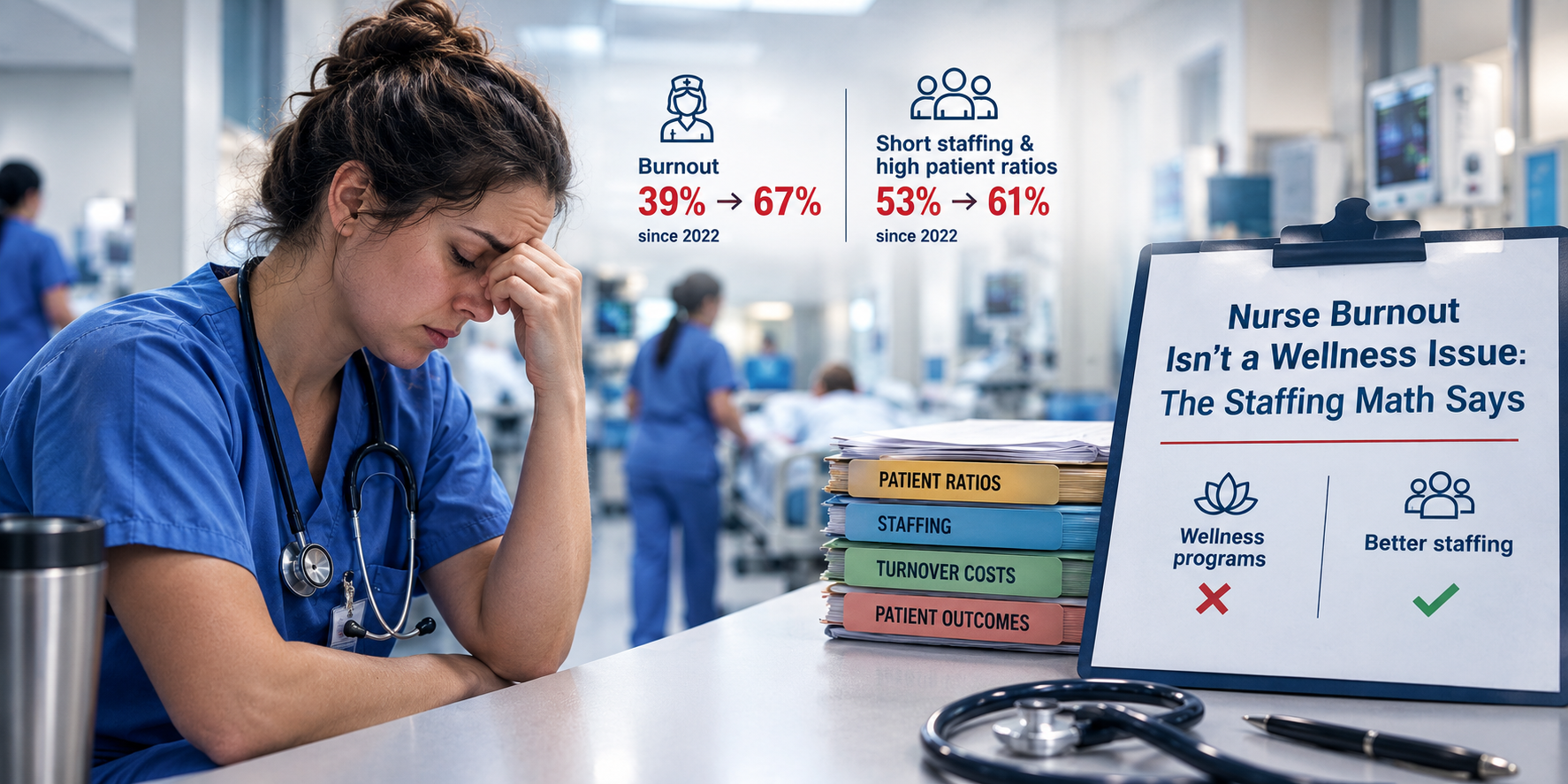
Nurse burnout has climbed from 39% to 67% since 2022, according to a survey of more than 2,000 nurses and nursing students from Cross Country Healthcare and Florida Atlantic University (Florida Atlantic University). In the same survey, short staffing and high patient ratios rose from 53% to 61%. Hospitals keep answering with wellness programs, and the math says that is the wrong lever.
Is nurse burnout a wellness problem or a staffing problem?
It is mostly a staffing problem, and the evidence is old and steady. In a JAMA study of 168 Pennsylvania hospitals, every extra patient on a nurse’s load raised the odds of burnout by 23% and the odds of job dissatisfaction by 15% (JAMA). The same study tied each added patient to a 7% rise in 30-day surgical mortality.
Think about what that means. One dial moves patient risk and nurse burnout at the same time. A meditation room does not touch either one.
Scale it up, and the gap gets wider. Researchers estimated that a nationwide 8-to-1 ratio, compared with 4-to-1, would mean a 31% higher mortality rate, or about 20,000 additional deaths (California Healthline).
What is actually happening here?
Nurses are leaving at a rate hospitals can count in dollars. The 2026 NSI retention report found staff RN turnover hit 17.6% in 2025, up 1.2 points, and each lost bedside RN cost $60,090 on average (Becker’s Hospital Review). That adds up to about $5.19 million a year for the average hospital.
Burnout is the pipeline into those exits. In the 2002 study, nurses with both high burnout and dissatisfaction were far more likely to plan to leave within a year, 43% compared with 11% for nurses without them (NIH NINR). Burned-out nurses are already halfway out the door.
Not every unit bleeds the same. NSI found behavioral health at 22.5% turnover, emergency at 20.7%, telemetry at 19.5%, and step-down at 19%, all above the national average (Becker’s Hospital Review).
What are the experts saying?
Linda Aiken is the founding director of the Center for Health Outcomes and Policy Research at the University of Pennsylvania School of Nursing. She led a study published in JAMA Network Open in November 2025 and called investing in nurses a “two-for-one” solution, because it helps nurse and physician well-being while also strengthening patient care (HealthDay via MedicineNet).
The data behind that line is striking. In U.S. hospitals, a 10% improvement in the nurse work environment, which included added staffing, was tied to a 10% drop in high burnout among doctors (HealthDay via MedicineNet).
Here’s my take. We run physician wellness and nurse wellness as separate programs with separate budgets. One staffing decision moved both groups, and that should bother anyone who signs off on those budgets.
The part most articles skip
The fight is not about whether staffing works. It is about who sets the number. The American Nurses Association backs minimum ratios set by nurse-centered committees, while the American Organization for Nursing Leadership says leaders, managers and bedside nurses should align staffing, not policymakers (AACN).
Skeptics say the research is just correlation. Queensland ran something closer to an experiment, phasing in minimum ratios in two stages, and the first-phase hospitals saw bigger drops in mortality, readmissions and length of stay than hospitals still waiting (AHCJ). Hospitals counter that mandates cut flexibility and raise prices, though some analyses suggest added staffing largely pays for itself, and Aiken’s New York work estimated a 4-to-1 ratio would have avoided more than 4,370 deaths and saved at least $720 million over two years among Medicare patients alone (Healthcare Finance News).
The budget system hides the savings. AACN points out that hospitals book nurses as a cost without a matching revenue line, so staffing looks like pure expense even when the New York estimate counted savings from shorter stays and fewer readmissions (AACN). That is how a program that pays for itself keeps losing the budget fight.
A quick number that matters
$60,090 is the average cost of replacing one bedside RN. (NSI)
What does this mean for nurse leaders and hospital finance teams?
Move staffing out of the wellness bucket and into the retention bucket. Then do the math with your own numbers.
Here is an illustration. Say you employ 400 RNs. At the national 17.6% turnover rate, about 70 leave in a year, and at $60,090 each that is roughly $4.2 million. If better staffing cut turnover by three points, 12 fewer nurses would leave and you would keep about $721,000 (NSI).
- Pull turnover by unit, not hospital-wide. The hot spots hide inside the average.
- Multiply exits by $60,090 to set your baseline cost of churn.
- Map patients per nurse by shift on your worst units. Remember the JAMA link of 23% higher burnout odds for each added patient.
- Price a one-patient reduction on those units against your baseline. Count the overtime and agency spend you would stop paying.
- Present it as retention savings. NSI estimates each one-point change in RN turnover moves the average hospital by $295,000 a year (Becker’s Hospital Review).
- Keep your wellness programs, but stop counting them as the staffing fix.
Watch the gap between your numbers and the best performers. Magnet-recognized hospitals reported a 7.3% RN vacancy rate against 8.6% nationally in the NSI data (Nurse.org). If your vacancy rate sits above the national figure, your staffing plan is the first place to look.
A burned-out nurse is a nurse counting the days. Which of your units is counting the days fastest?
Leave a Reply