Blog

  • Nurse Burnout Isn’t a Wellness Issue: The Staffing Math Says

    Nurse Burnout Isn’t a Wellness Issue: The Staffing Math Says

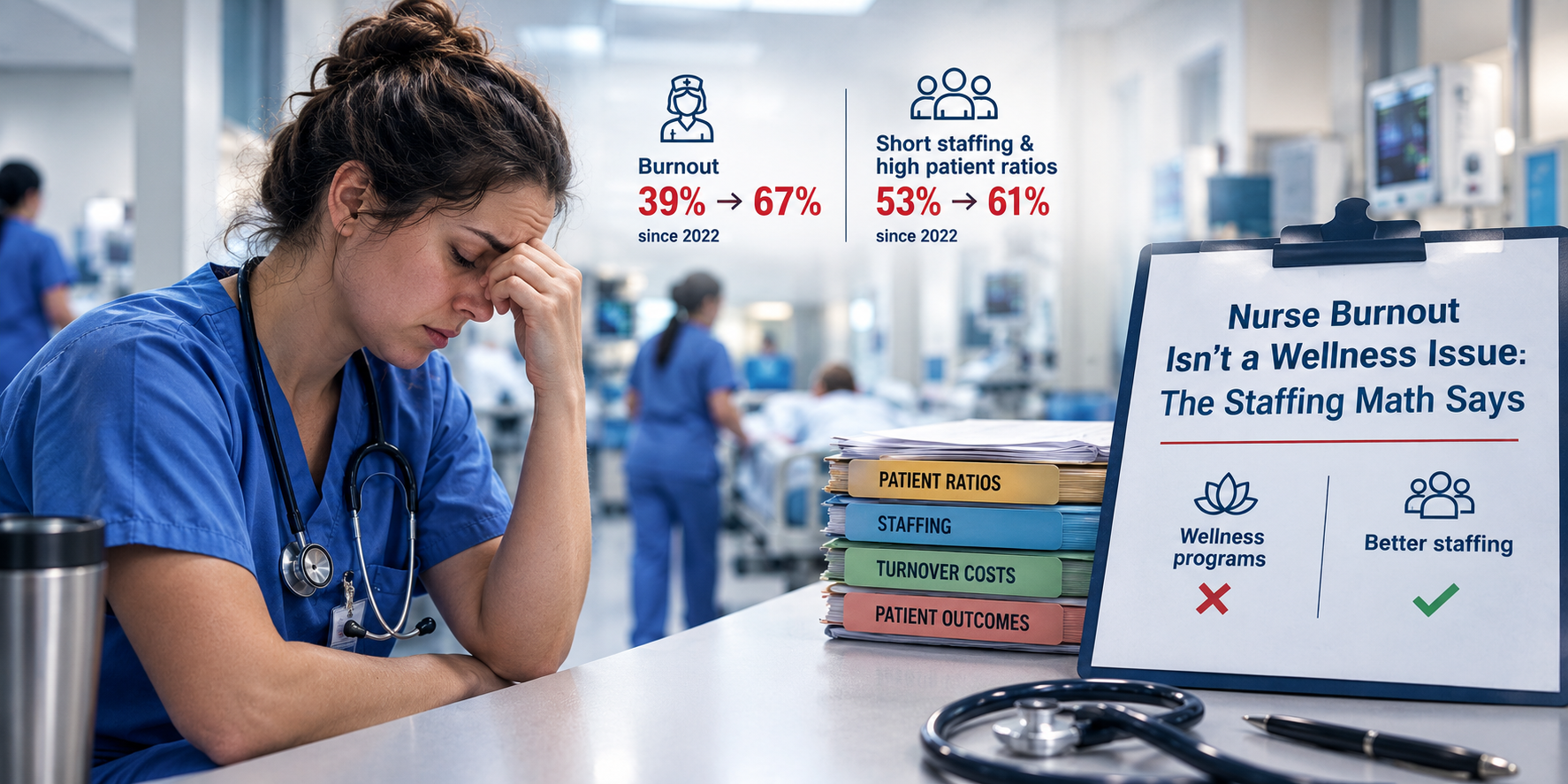
    Nurse burnout has climbed from 39% to 67% since 2022, according to a survey of more than 2,000 nurses and nursing students from Cross Country Healthcare and Florida Atlantic University (Florida Atlantic University). In the same survey, short staffing and high patient ratios rose from 53% to 61%. Hospitals keep answering with wellness programs, and the math says that is the wrong lever.

    Is nurse burnout a wellness problem or a staffing problem?

    It is mostly a staffing problem, and the evidence is old and steady. In a JAMA study of 168 Pennsylvania hospitals, every extra patient on a nurse’s load raised the odds of burnout by 23% and the odds of job dissatisfaction by 15% (JAMA). The same study tied each added patient to a 7% rise in 30-day surgical mortality.

    Think about what that means. One dial moves patient risk and nurse burnout at the same time. A meditation room does not touch either one.

    Scale it up, and the gap gets wider. Researchers estimated that a nationwide 8-to-1 ratio, compared with 4-to-1, would mean a 31% higher mortality rate, or about 20,000 additional deaths (California Healthline).

    What is actually happening here?

    Nurses are leaving at a rate hospitals can count in dollars. The 2026 NSI retention report found staff RN turnover hit 17.6% in 2025, up 1.2 points, and each lost bedside RN cost $60,090 on average (Becker’s Hospital Review). That adds up to about $5.19 million a year for the average hospital.

    Burnout is the pipeline into those exits. In the 2002 study, nurses with both high burnout and dissatisfaction were far more likely to plan to leave within a year, 43% compared with 11% for nurses without them (NIH NINR). Burned-out nurses are already halfway out the door.

    Not every unit bleeds the same. NSI found behavioral health at 22.5% turnover, emergency at 20.7%, telemetry at 19.5%, and step-down at 19%, all above the national average (Becker’s Hospital Review).

    What are the experts saying?

    Linda Aiken is the founding director of the Center for Health Outcomes and Policy Research at the University of Pennsylvania School of Nursing. She led a study published in JAMA Network Open in November 2025 and called investing in nurses a “two-for-one” solution, because it helps nurse and physician well-being while also strengthening patient care (HealthDay via MedicineNet).

    The data behind that line is striking. In U.S. hospitals, a 10% improvement in the nurse work environment, which included added staffing, was tied to a 10% drop in high burnout among doctors (HealthDay via MedicineNet).

    Here’s my take. We run physician wellness and nurse wellness as separate programs with separate budgets. One staffing decision moved both groups, and that should bother anyone who signs off on those budgets.

    The part most articles skip

    The fight is not about whether staffing works. It is about who sets the number. The American Nurses Association backs minimum ratios set by nurse-centered committees, while the American Organization for Nursing Leadership says leaders, managers and bedside nurses should align staffing, not policymakers (AACN).

    Skeptics say the research is just correlation. Queensland ran something closer to an experiment, phasing in minimum ratios in two stages, and the first-phase hospitals saw bigger drops in mortality, readmissions and length of stay than hospitals still waiting (AHCJ). Hospitals counter that mandates cut flexibility and raise prices, though some analyses suggest added staffing largely pays for itself, and Aiken’s New York work estimated a 4-to-1 ratio would have avoided more than 4,370 deaths and saved at least $720 million over two years among Medicare patients alone (Healthcare Finance News).

    The budget system hides the savings. AACN points out that hospitals book nurses as a cost without a matching revenue line, so staffing looks like pure expense even when the New York estimate counted savings from shorter stays and fewer readmissions (AACN). That is how a program that pays for itself keeps losing the budget fight.

    A quick number that matters

    $60,090 is the average cost of replacing one bedside RN. (NSI)

    What does this mean for nurse leaders and hospital finance teams?

    Move staffing out of the wellness bucket and into the retention bucket. Then do the math with your own numbers.

    Here is an illustration. Say you employ 400 RNs. At the national 17.6% turnover rate, about 70 leave in a year, and at $60,090 each that is roughly $4.2 million. If better staffing cut turnover by three points, 12 fewer nurses would leave and you would keep about $721,000 (NSI).

    1. Pull turnover by unit, not hospital-wide. The hot spots hide inside the average.
    2. Multiply exits by $60,090 to set your baseline cost of churn.
    3. Map patients per nurse by shift on your worst units. Remember the JAMA link of 23% higher burnout odds for each added patient.
    4. Price a one-patient reduction on those units against your baseline. Count the overtime and agency spend you would stop paying.
    5. Present it as retention savings. NSI estimates each one-point change in RN turnover moves the average hospital by $295,000 a year (Becker’s Hospital Review).
    6. Keep your wellness programs, but stop counting them as the staffing fix.

    Watch the gap between your numbers and the best performers. Magnet-recognized hospitals reported a 7.3% RN vacancy rate against 8.6% nationally in the NSI data (Nurse.org). If your vacancy rate sits above the national figure, your staffing plan is the first place to look.

    A burned-out nurse is a nurse counting the days. Which of your units is counting the days fastest?
  • Why Hospital Margins Slip When Medicaid Rules Change Midyear

    Why Hospital Margins Slip When Medicaid Rules Change Midyear

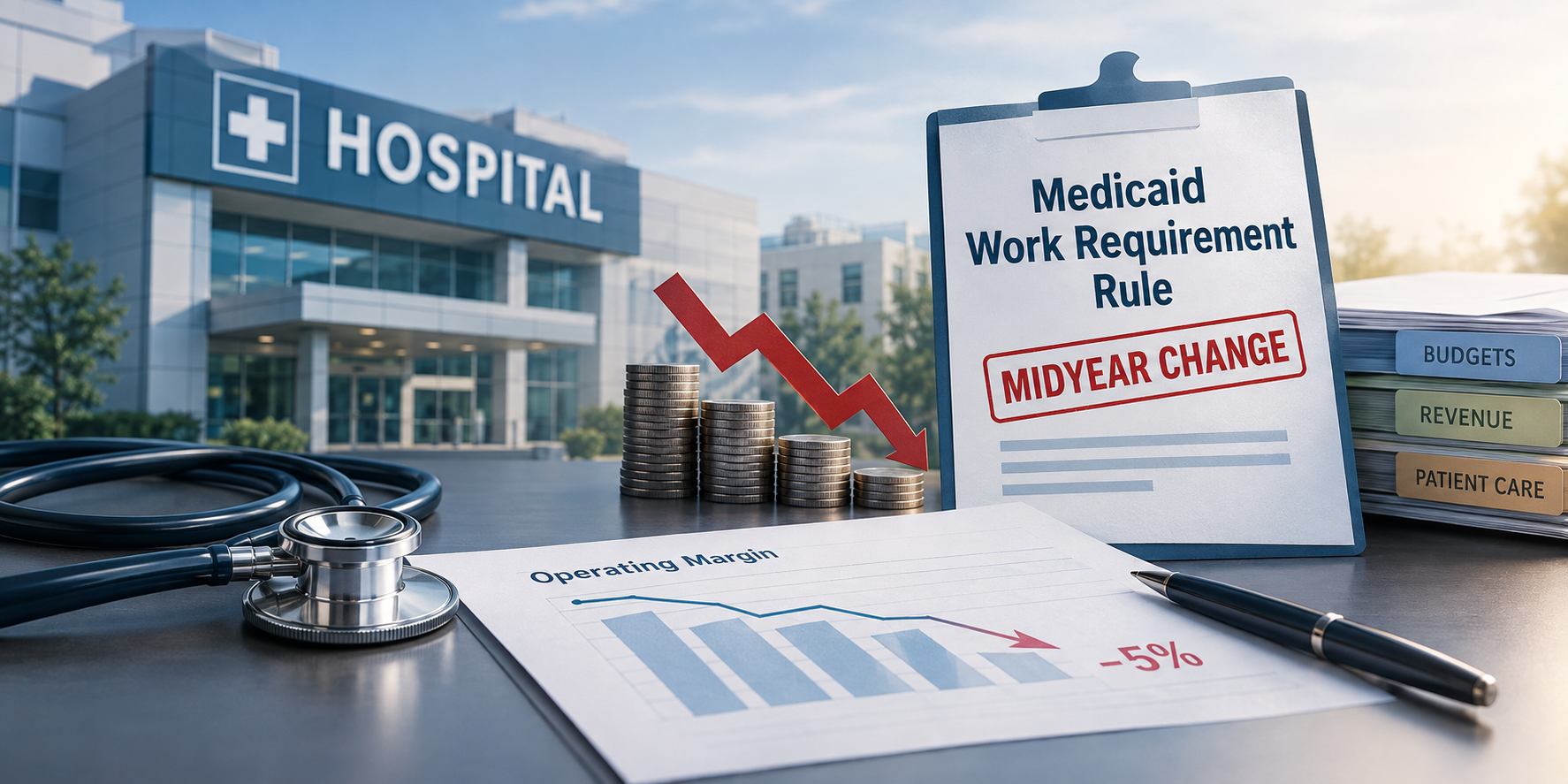
    Hospital operating margins fell 5% year over year through May, according to Kaufman Hall’s national flash report (Becker’s Hospital Review). Then CMS published the Medicaid work requirement rule on June 1, skipping the usual proposed version and leaving hospitals a thin window to respond (Becker’s Hospital Review). Most budgets were already locked.

    Why do hospital margins drop when Medicaid rules change midyear?

    The short answer is that revenue leaves faster than cost does. A patient who loses Medicaid still needs care, but the payment for that care is gone. The Commonwealth Fund’s hospital model assumes costs fall about 44% when a patient moves from insured to uncompensated care, which helps, but costs still fall by less than the payment does (Commonwealth Fund).

    Timing makes it worse. Nebraska started enforcing work requirements in May, Montana was set to follow in July, and every other state has to be running by January 1, 2027 (Becker’s Hospital Review). Hospital budgets run on annual cycles, and these rules do not.

    What is actually happening here?

    Congress wrote the work requirement into HR 1. Adults ages 19 to 64 in expansion coverage must show 80 hours a month of work, school or community service to keep Medicaid. CMS then used an interim final rule, which means the normal proposal and comment round never happened first (Becker’s Hospital Review).

    The money picture was already soft. By June, Kaufman Hall’s year-to-date operating margin index sat at 2.5%, down 6% from the first half of 2025, and uncompensated care as a share of gross operating revenue ran 8% higher (Advisory Board). That is before work requirements hit at scale.

    Here is why a small revenue loss turns into a big margin problem. The Commonwealth Fund modeled a full rollout in 2027 and found operating revenue falling only 0.9% to 1.0% for the average hospital in expansion states, yet operating margins shrink by 11.7% to 13.3% (Commonwealth Fund). Safety-net hospitals fare worse, with margins down 25.9% to 29.6%, which would take a 2% margin to roughly 1.45%.

    What are the experts saying?

    Jennifer DeCubellis, president and CEO of America’s Essential Hospitals, said in a statement quoted by Becker’s that CMS’s plan for community engagement requirements “goes beyond what Congress intended” (Becker’s Hospital Review). She warned that the added paperwork will leave more eligible people without coverage and raise uncompensated care costs at essential hospitals.

    CMS sees it differently. Administrator Mehmet Oz has pitched 2027 as a forgiving year, since states can accept self-attestation while they build data checks.

    Kaufman Hall’s Erik Swanson, a managing director, said earlier this year that rising bad debt, charity care, and a bigger public payer share point to a lingering “new normal” for hospitals (DOTmed).

    Here’s my take. Both sides can be right, and that is the problem. A forgiving first year is not a forgiving first budget, and a hospital that models 2027 off the soft rules and 2028 off nothing will be explaining a miss to its board.

    The part most articles skip

    The rule gets tighter in 2028. In 2027, states can accept self-attestation, but in 2028 they can lean on a person’s own statement only once and only for certain exemptions, which is when disenrollment risk climbs (Becker’s Hospital Review). Budgets built on the 2027 rules will look wrong a year later.

    Most people who lose coverage will not lose it because they refuse to work. The Commonwealth Fund notes that the vast majority of people subject to the rule either work or qualify for an exemption, and that millions could still lose coverage because reporting and verification are hard (Commonwealth Fund). CMS itself estimated that each state faces about $15 million to upgrade eligibility systems, which tells you how much plumbing is still unbuilt (Becker’s Hospital Review).

    The European Observatory’s monitor of U.S. health reforms flags a separate squeeze. It expects lower provider tax revenue for state Medicaid programs in 22 expansion states, mostly from taxes on hospitals’ net patient revenue (European Observatory). Fewer people on the rolls and less state money behind the program is a two-sided problem for the same hospital.

    The one number to put in your budget deck

    CBO estimates work requirements alone raise the number of uninsured people by 4.8 million in 2034. (KFF)

    How should hospital finance teams prepare before January 1?

    Start with your own exposure, not the national averages. Most of this takes a data pull and a calculator.

    1. Pull twelve months of Medicaid expansion volume and revenue by service line. Flag patients ages 19 to 64, because they are the group the rule covers.
    2. Build two scenarios, a soft 2027 and a tighter 2028. Use the Commonwealth Fund ranges as your outer bound and not your base case, since their model assumes every expansion state rolls out in 2027.
    3. Size it with a quick illustration. The Commonwealth Fund puts average Medicaid revenue at about $37 million for acute-care hospitals that are not safety-net, and it projects Medicaid revenue falling 8.7% to 9.9% on average, so that hospital would lose roughly $3.2 million to $3.7 million (Commonwealth Fund).
    4. Build outreach lists now. Consultants and hospital advocates are telling hospitals to identify the Medicaid patients likely subject to the rule, run prioritized outreach, and help patients verify coverage (HFMA).
    5. Get ready for frailty paperwork. In KFF’s survey, 30 states said they plan to bring hospitals in to verify medical frailty when needed (HFMA).
    6. Track self-pay share, last-minute denials, and bad debt every month. Compare against Kaufman Hall’s national trend so you can tell your own problem from the market’s.
    7. Show your board ranges instead of one number. A range survives a rule change in a way a point estimate will not.

    Watch Nebraska. The state started in May, and its hospital association built a website to help patients and pushed member hospitals to do outreach (Bloomberg Government). Its early numbers are the closest thing anyone has to a preview.

    Then ask your state which data it will check first. The Commonwealth Fund warns that without systems that verify work or exemptions automatically, many enrollees will have to prove it by hand, which raises the odds that eligible people lose coverage (Commonwealth Fund). A state with good data matching costs you fewer patients than a state running on paper.

    Rules change in a month, and budgets change in a year. Which one is your finance team planning around?


  • Prompt Libraries Fail After Month Two: What We Built Instead

    Prompt Libraries Fail After Month Two: What We Built Instead

    GPT-4 got 84% of prime number questions right in March 2023. Same model name, same questions, and by June it got 51% (Harvard Data Science Review). The ground is shifting again this month too, with OpenAI’s October model plans reportedly changing and Gemini 4 looking like a later-2026 release (The Hans India).

    What is actually happening here

    We had a prompt library. It was one big shared doc with tidy folders, a naming scheme everybody followed for about two weeks, and a rule that you copy a prompt instead of editing it. It felt like an asset, and for the first month or so it really was.

    Then month two hit. Outputs got weirder, summaries crept longer, and a classifier started tagging things it never used to tag. Nobody could say what changed, because nobody could say which copy was current, and we lost days arguing about whose prompt was wrong before anyone asked if the ground had moved.

    That is not just our mess. Researchers studied 1,262 prompt changes across 243 GitHub repositories and found that edits can introduce logical inconsistencies, and that prompts often fall out of step with what the model actually returns (arXiv). A library treats prompts like finished things you collect, but they are code written in English, and they break like code, usually at the worst possible time.

    What the experts are saying

    James Zou is a Stanford computer science professor and a co-author of the paper behind that 84% to 51% drop. He told Fortune that the main message of the work is to show that “these large language model drifts do happen” (Fortune, July 2023). That is a researcher describing something he measured, not a user venting on a forum.

    Peter Welinder was OpenAI’s VP of Product when the paper blew up, and he pushed back in public:

    [Peter Welinder on Twitter: “No, we haven’t made GPT-4 dumber.”] – https://twitter.com/npew/status/1679538687854661637

    He went on to suggest that heavy users simply start noticing flaws they never saw before (The Decoder). It’s a fair theory, and it’s also useless to you at 2 a.m. when your pipeline is returning garbage.

    My take is that both sides can be right, and that is the annoying part. A vendor can honestly ship a model that is better on average while your prompt, tuned to the old behavior, quietly falls apart. Smarter overall is not the same as the same on your task, and your task is the only one that pays you.

    The part most articles skip

    Every article tells you to version your prompts. Fine, do it, but a version number only tells you what changed. It says nothing about whether the change was any good, and almost nobody says that out loud.

    The fix that looks safe is often the dangerous one. In a controlled study, adding generic improvement rules to a prompt dropped one model’s RAG task from 26 passing cases out of 30 to 9 out of 30 (arXiv). It was a small local model on a small test set, so I won’t call it a law, but a cleanup that reads like an upgrade broke a task nobody was watching, and that is exactly how a shared library gets edited.

    Now stack the model underneath it. The Stanford authors said a drop in GPT-4’s ability to follow instructions was one common factor behind the drifts they saw (Harvard Data Science Review). Instruction following is the thing every carefully worded prompt in your library leans on, so edit risk and model risk pile up together, and a doc full of text snippets can see neither one.

    A quick number that matters

    Only 21.9% of those prompt changes were explained in a commit message, so most edits left no record of what changed or why. (arXiv)

    What this means for teams shipping AI features

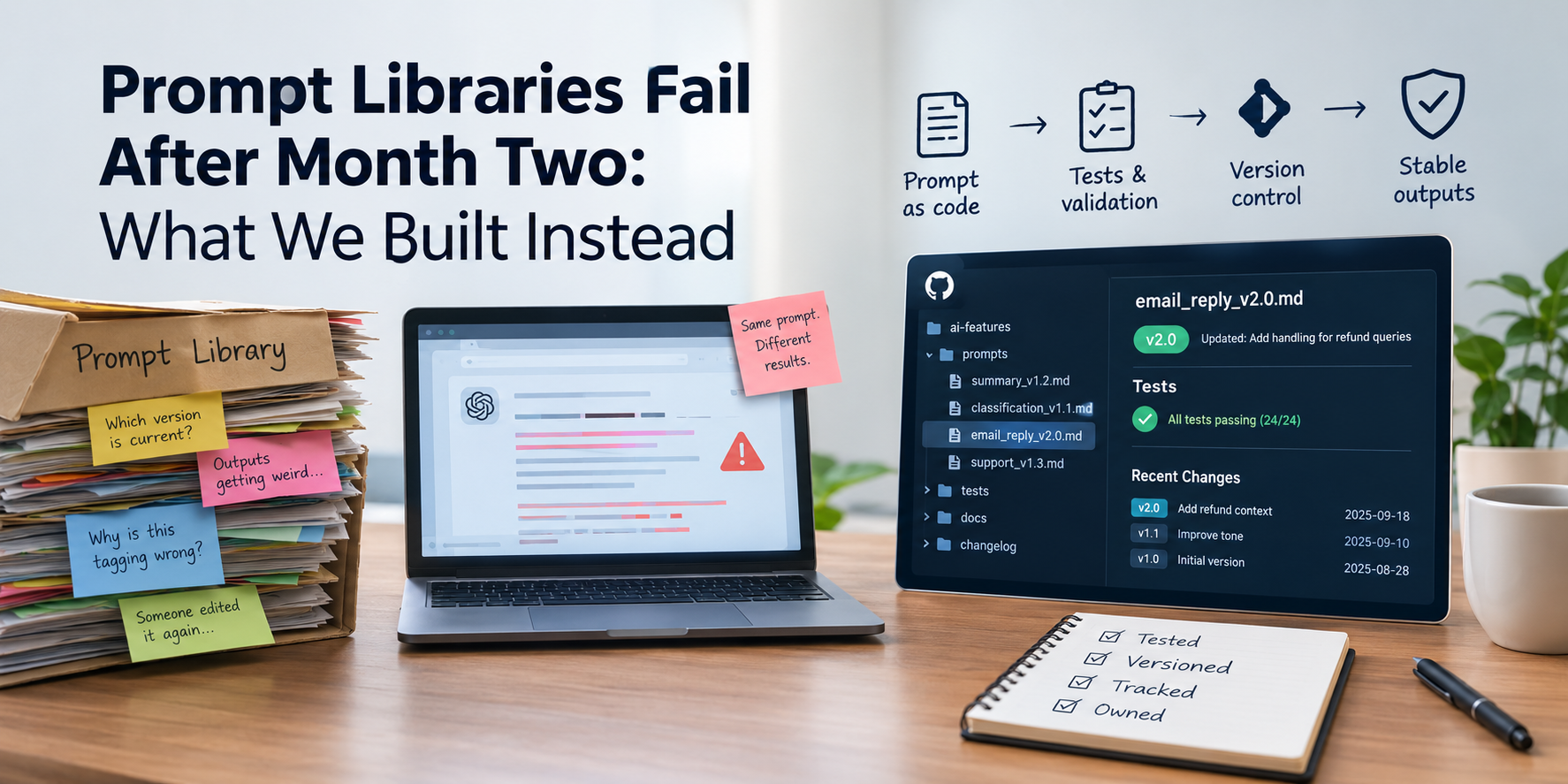
    Stop treating prompts as content and start treating them as code. That is the whole shift, and it is what we built instead. Prompts now live in the repo next to the feature they power, one file each, with a version number and a one-line reason attached to every edit, and the old doc is read-only so nobody drifts back to the old habit.

    Here is the routine that keeps it honest:

    1. Give every prompt a test set of real inputs, plus the outputs you would accept. Twenty to fifty cases is enough to start. Add a new case every time something breaks in production, so the set remembers your worst days.
    2. Block any prompt edit from merging until the whole set passes. Tiny edits get no exception, because tiny edits are where drops like that 26-to-9 hide. If an edit makes one case better and two cases worse, you want to see that before it ships.
    3. Pin the model version in production and rerun the full set on a schedule. Weekly works for most teams, and daily is better if customers see the output directly. The schedule is what catches the changes nobody announces.
    4. Log the prompt version and the model name next to every output. Without that you cannot tell a prompt problem from a model problem. You will burn a day guessing, and then another day guessing again.
    5. Treat a score drop with no prompt change as drift. That is the signal the Stanford team was warning about, and it is the one a shared doc can never give you. Look into it before a customer writes in, not after.
    6. Give each prompt one owner. Shared ownership is how our library died, because everybody could edit and nobody was responsible. One name on the file fixes more than any tool will.
    7. Write a changelog line for every edit, even the boring ones. Only 21.9% of edits in those repos got that treatment, so you can beat the field without trying hard. Six months from now that line is the only memory you have.
    8. Keep a few ugly inputs in every test set. Empty fields, typos, a customer who writes in all caps. Prompts that look great on clean examples tend to fall over first on the messy ones.
    9. Read the failing cases by hand. An average score hides the weird ones, and the weird ones teach you the most. We learned more from a handful of bad outputs than from any dashboard.

    Watch the next few weeks closely. If the October release plans keep moving, you may get pushed to swap models sooner than you wanted. Run the new model against your test set in parallel first, and let it fail in private where it costs you nothing.

    The failures are the useful part. They show what your prompt was secretly leaning on, like a formatting habit or a quirk of the old model. Fix those and you get a prompt that holds up through the next update, not just this one.

    A library stores prompts and never tells you when one stops working. So which of yours would you bet is still passing today?

  • Hello world!

    Welcome to WordPress. This is your first post. Edit or delete it, then start writing!