GPT-4 got 84% of prime number questions right in March 2023. Same model name, same questions, and by June it got 51% (Harvard Data Science Review). The ground is shifting again this month too, with OpenAI’s October model plans reportedly changing and Gemini 4 looking like a later-2026 release (The Hans India).
What is actually happening here
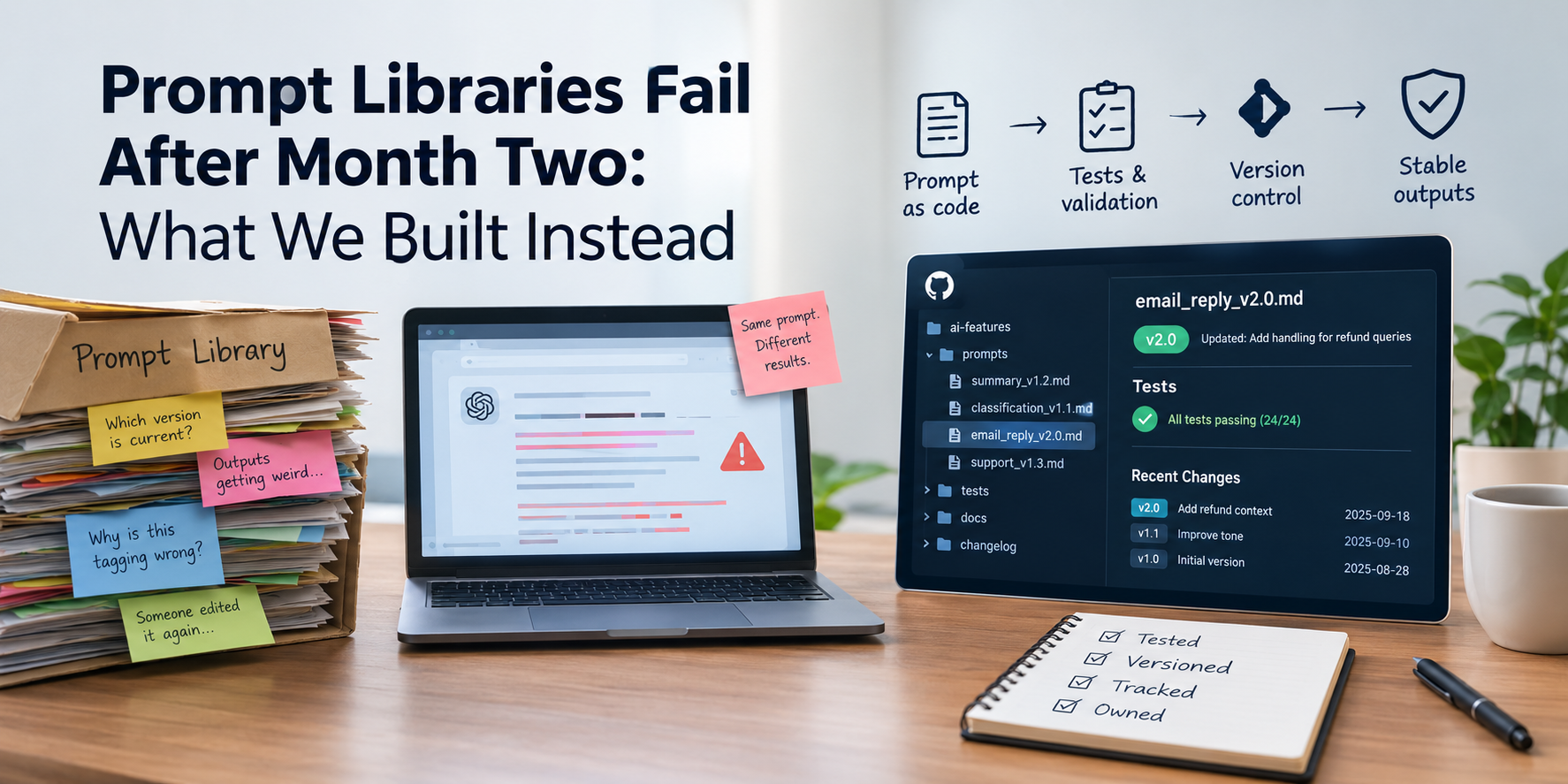
We had a prompt library. It was one big shared doc with tidy folders, a naming scheme everybody followed for about two weeks, and a rule that you copy a prompt instead of editing it. It felt like an asset, and for the first month or so it really was.
Then month two hit. Outputs got weirder, summaries crept longer, and a classifier started tagging things it never used to tag. Nobody could say what changed, because nobody could say which copy was current, and we lost days arguing about whose prompt was wrong before anyone asked if the ground had moved.
That is not just our mess. Researchers studied 1,262 prompt changes across 243 GitHub repositories and found that edits can introduce logical inconsistencies, and that prompts often fall out of step with what the model actually returns (arXiv). A library treats prompts like finished things you collect, but they are code written in English, and they break like code, usually at the worst possible time.
What the experts are saying
James Zou is a Stanford computer science professor and a co-author of the paper behind that 84% to 51% drop. He told Fortune that the main message of the work is to show that “these large language model drifts do happen” (Fortune, July 2023). That is a researcher describing something he measured, not a user venting on a forum.
Peter Welinder was OpenAI’s VP of Product when the paper blew up, and he pushed back in public:
[Peter Welinder on Twitter: “No, we haven’t made GPT-4 dumber.”] – https://twitter.com/npew/status/1679538687854661637
He went on to suggest that heavy users simply start noticing flaws they never saw before (The Decoder). It’s a fair theory, and it’s also useless to you at 2 a.m. when your pipeline is returning garbage.
My take is that both sides can be right, and that is the annoying part. A vendor can honestly ship a model that is better on average while your prompt, tuned to the old behavior, quietly falls apart. Smarter overall is not the same as the same on your task, and your task is the only one that pays you.
The part most articles skip
Every article tells you to version your prompts. Fine, do it, but a version number only tells you what changed. It says nothing about whether the change was any good, and almost nobody says that out loud.
The fix that looks safe is often the dangerous one. In a controlled study, adding generic improvement rules to a prompt dropped one model’s RAG task from 26 passing cases out of 30 to 9 out of 30 (arXiv). It was a small local model on a small test set, so I won’t call it a law, but a cleanup that reads like an upgrade broke a task nobody was watching, and that is exactly how a shared library gets edited.
Now stack the model underneath it. The Stanford authors said a drop in GPT-4’s ability to follow instructions was one common factor behind the drifts they saw (Harvard Data Science Review). Instruction following is the thing every carefully worded prompt in your library leans on, so edit risk and model risk pile up together, and a doc full of text snippets can see neither one.
A quick number that matters
Only 21.9% of those prompt changes were explained in a commit message, so most edits left no record of what changed or why. (arXiv)
What this means for teams shipping AI features
Stop treating prompts as content and start treating them as code. That is the whole shift, and it is what we built instead. Prompts now live in the repo next to the feature they power, one file each, with a version number and a one-line reason attached to every edit, and the old doc is read-only so nobody drifts back to the old habit.
Here is the routine that keeps it honest:
- Give every prompt a test set of real inputs, plus the outputs you would accept. Twenty to fifty cases is enough to start. Add a new case every time something breaks in production, so the set remembers your worst days.
- Block any prompt edit from merging until the whole set passes. Tiny edits get no exception, because tiny edits are where drops like that 26-to-9 hide. If an edit makes one case better and two cases worse, you want to see that before it ships.
- Pin the model version in production and rerun the full set on a schedule. Weekly works for most teams, and daily is better if customers see the output directly. The schedule is what catches the changes nobody announces.
- Log the prompt version and the model name next to every output. Without that you cannot tell a prompt problem from a model problem. You will burn a day guessing, and then another day guessing again.
- Treat a score drop with no prompt change as drift. That is the signal the Stanford team was warning about, and it is the one a shared doc can never give you. Look into it before a customer writes in, not after.
- Give each prompt one owner. Shared ownership is how our library died, because everybody could edit and nobody was responsible. One name on the file fixes more than any tool will.
- Write a changelog line for every edit, even the boring ones. Only 21.9% of edits in those repos got that treatment, so you can beat the field without trying hard. Six months from now that line is the only memory you have.
- Keep a few ugly inputs in every test set. Empty fields, typos, a customer who writes in all caps. Prompts that look great on clean examples tend to fall over first on the messy ones.
- Read the failing cases by hand. An average score hides the weird ones, and the weird ones teach you the most. We learned more from a handful of bad outputs than from any dashboard.
Watch the next few weeks closely. If the October release plans keep moving, you may get pushed to swap models sooner than you wanted. Run the new model against your test set in parallel first, and let it fail in private where it costs you nothing.
The failures are the useful part. They show what your prompt was secretly leaning on, like a formatting habit or a quirk of the old model. Fix those and you get a prompt that holds up through the next update, not just this one.
A library stores prompts and never tells you when one stops working. So which of yours would you bet is still passing today?
Leave a Reply