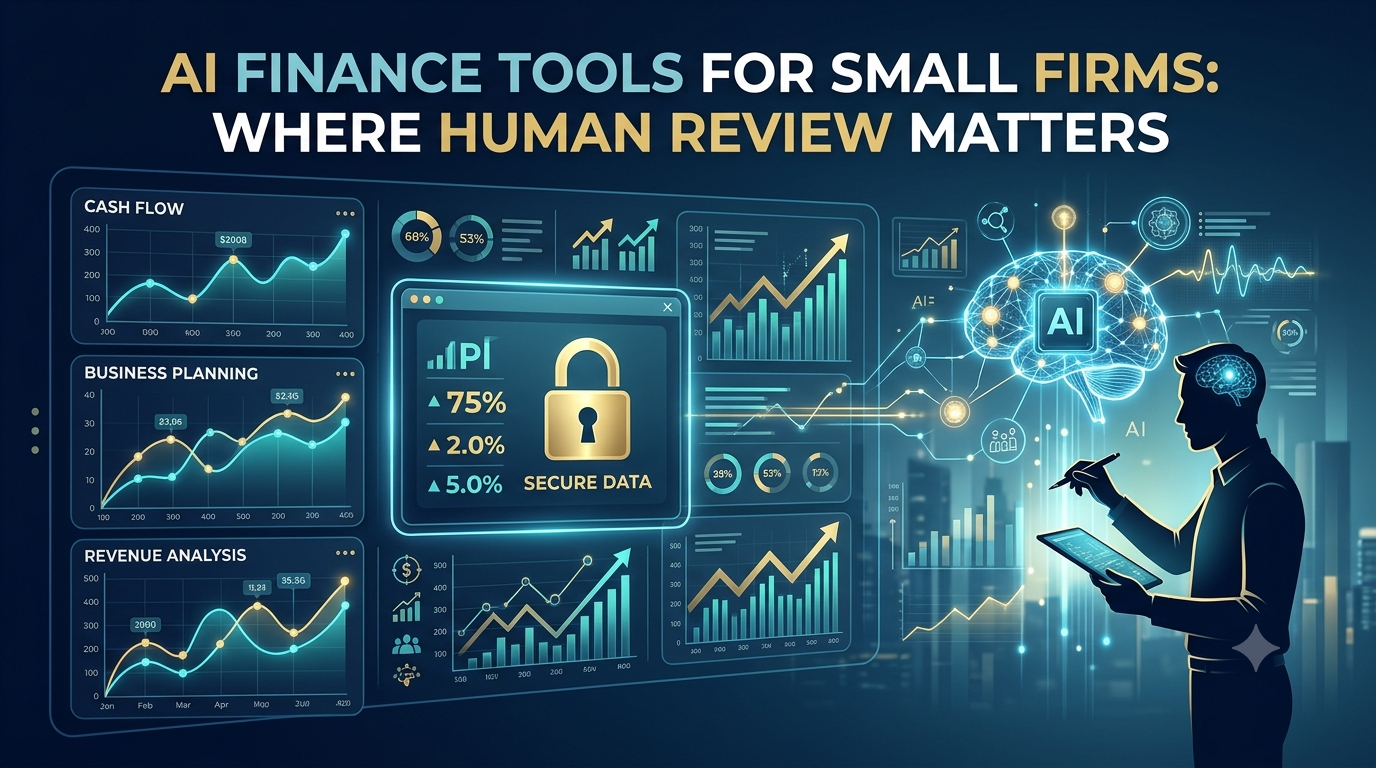
An AI finance tool can prepare a cash flow forecast in minutes. But if the sales figures are incomplete or a major invoice is missing, that forecast can still lead a business owner in the wrong direction.
Small businesses are turning to AI to reduce manual work, analyse financial information and make routine decisions faster. These tools can help, especially when a company has limited finance staff.
The risk starts when a recommendation looks precise enough to trust without checking how it was produced.
On October 15, 2026, Reuters reported that the Financial Stability Board had called for stronger human oversight of agentic AI in financial institutions. The report focused on financial stability, but the underlying concern also matters to smaller firms. An AI system that can take action needs clear limits and accountable human oversight.
For a small business, the goal should be to use AI to improve financial decisions without handing over responsibility for them.
Which AI finance tools can help small businesses?
The right tool depends on the job. A business that struggles with late invoices has different needs from one that wants to forecast cash flow or review spending.
AI bookkeeping and transaction categorisation
Bookkeeping tools can help classify transactions, match payments and flag unusual entries.
For example, a tool may recognise a recurring software subscription and suggest the same expense category used in previous months. It can also flag a transaction that does not match the usual pattern.
This saves time when transactions are routine and the underlying records are reliable.
But transaction descriptions can be unclear. A payment to a supplier may cover several products or include a personal expense that needs separate treatment. An automated system may assign a plausible category without understanding the full context.
Review unusual entries, large transactions and items that affect tax reporting. Reconcile bank accounts regularly rather than assuming that automated categorisation means the books are correct.
AI cash flow forecasting
Cash flow forecasting helps a business estimate whether it will have enough money to meet upcoming expenses.
AI tools can analyse past income and spending, recurring payments, invoice dates and other available information. They may help identify periods when cash is likely to become tight.
Suppose a business expects several large customer payments next month. An AI forecast may suggest that the expected income will cover wages, rent and supplier invoices.
That forecast is only as reliable as its inputs. If a customer pays late or an expected order falls through, the result changes.
Review forecasts against current bank balances, unpaid invoices, committed expenses and realistic payment dates. Test what happens if an important customer pays late or sales fall below expectations.
A useful forecast should show its assumptions, not just one predicted balance.
AI invoice processing and payment reminders
AI can extract information from invoices, identify due dates and prepare reminders for overdue payments.
This can help a small team manage accounts receivable without checking every invoice manually.
However, invoice automation needs controls around supplier identity, bank details and payment approval.
A fraudulent invoice may look similar to a legitimate one. An altered bank account or duplicate payment request can create a direct financial loss.
Use established verification procedures for changes to supplier details. Require authorised staff to approve payments above defined limits. Do not allow an AI agent to bypass these checks simply because an invoice appears urgent.
AI budgeting and expense analysis
AI tools can group expenses, compare spending across periods and identify changes that need attention.
A business owner may use them to find rising software costs, increased delivery charges or recurring subscriptions that are no longer needed.
These insights can support better budgeting, but the system needs context.
An increase in advertising costs may reflect a planned seasonal campaign. Higher travel expenses may be linked to a new customer contract. A large purchase may be a one-time investment rather than a sign of poor spending control.
Review the reason behind an unusual result before making a decision.
AI financial reporting
Some tools can turn financial records into written reports that explain revenue changes, expense patterns and possible cash flow problems.
This is useful for owners who understand their business better than they understand financial statements.
Still, a clear explanation is not proof that the analysis is correct. Check the figures against the underlying accounts and confirm that the tool is using the right period, currency and accounting categories.
If the report informs a loan application, investor update or major spending decision, have a qualified finance professional review the relevant information.
Where should human review be mandatory?
Human review should depend on the potential cost of a mistake.
Routine tasks with limited consequences can often be automated with periodic checks. Actions that affect money, legal obligations or confidential information need stronger controls.
| Finance task | Suitable AI role | Human control |
|---|---|---|
| Transaction categorisation | Suggest expense categories | Review unusual or material entries |
| Cash flow forecasting | Model possible outcomes | Check assumptions and major decisions |
| Invoice processing | Extract data and flag errors | Verify suppliers and payment details |
| Supplier payments | Prepare payment instructions | Approve release of funds |
| Tax preparation | Organise records and identify issues | Review filings with an appropriate professional |
| Financial planning | Compare possible scenarios | Decide based on business needs and risk |
The key distinction is between preparing a recommendation and authorising an action.
An AI tool may identify a supplier invoice as ready for payment. That does not mean it should have unrestricted permission to transfer money.
How to check whether an AI financial recommendation is reliable
Check the source data first
Before acting on a recommendation, confirm that the tool has the right information.
Look for missing transactions, duplicate invoices, outdated balances and incorrect payment dates. Check whether the forecast includes upcoming tax payments, loan repayments and other commitments.
If the data is incomplete, ask the tool to identify missing information rather than filling gaps with assumptions.
Ask how the result was calculated
A useful financial tool should help you understand the basis of its recommendation.
If it says cash flow will become negative next month, check which income and expenses drive that prediction. If it recommends reducing spending, ask which categories have changed and over what period.
Be careful when a tool gives a confident answer without showing the inputs or assumptions behind it.
The NIST AI Risk Management Framework offers guidance for identifying and managing AI risks. Its principles can help businesses think about reliability, transparency, accountability and ongoing evaluation.
Compare important decisions with another source
For a major financial decision, do not rely on a single AI-generated forecast.
Compare the result with your accounting records, bank statements and existing business forecasts. If the decision involves tax treatment, borrowing, investment or complex accounting, seek advice from a suitably qualified professional.
A second check is especially useful when the recommendation differs sharply from what the business owner expected.
How much financial authority should an AI agent have?
A business should decide which actions an agent can perform before connecting it to financial systems.
An agent that reads invoices and prepares a weekly report needs less authority than one that can approve refunds, update supplier records or initiate payments.
Start with read-only access wherever possible. Allow the agent to prepare recommendations before giving it permission to change records or trigger transactions.
If an agent needs to take action, set limits on the amounts, accounts and transaction types it can handle. Require additional approval when an action falls outside those limits.
Keep records of actions and approval decisions. Make sure someone can suspend access quickly if the agent behaves unexpectedly.
These controls are consistent with the risk management approach described in the NIST AI Risk Management Framework. The framework is voluntary, but it provides a useful structure for assessing how AI systems should be designed, used and monitored.
What about customer and financial data privacy?
Financial records may contain bank details, employee information, customer addresses and commercially sensitive data.
Before using an AI finance tool, check what information it collects, where that information is stored, who can access it and whether it may be used to train models.
Review the provider’s data retention terms and security controls. Check whether the tool supports access restrictions, audit logs and suitable data protection arrangements.
Avoid uploading full financial records to a general-purpose AI service unless your business has reviewed the service’s terms and approved the use.
Give each user and system access only to the information needed for the task. A marketing assistant should not automatically have access to payroll records because both systems use the same AI platform.
How should a small business introduce AI into finance?
Start with one task that takes time but carries limited risk. Invoice data extraction, expense categorisation or drafting a monthly financial report may be a sensible first test.
Run the tool alongside the existing process. Compare its output with the results produced by your staff or accounting system. Record errors, time saved and the amount of manual correction required.
Set clear acceptance criteria before expanding its role. For example, the tool may need to identify missing invoice details, preserve transaction values and flag uncertain entries for review.
Once the process is reliable, expand gradually. Keep human approval for high-impact actions and review performance when the business changes its systems, suppliers or workflows.
The best starting point is not the finance task that AI can perform most impressively. It is the task where automation can save meaningful time without creating more risk than the business can manage.