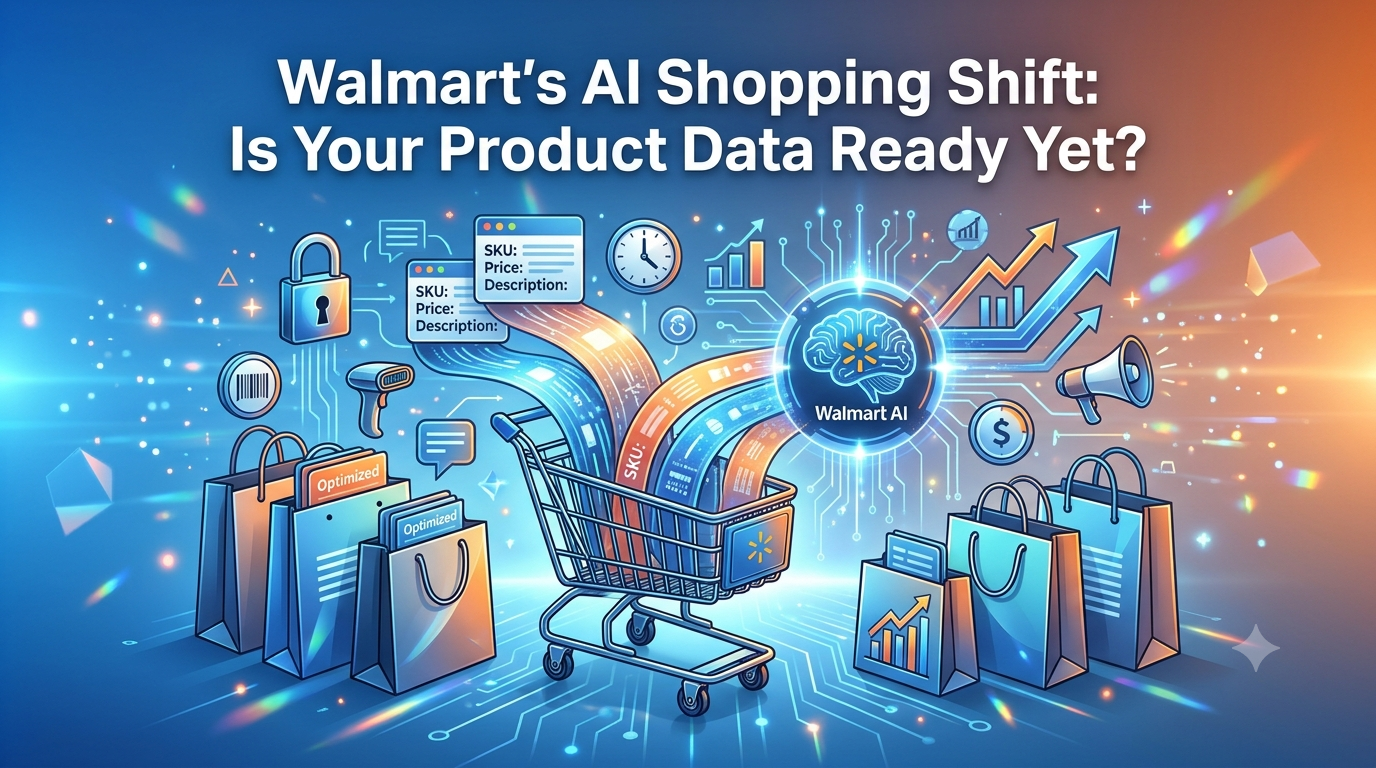
Walmart announced a new way for AI agents to shop on October 21, 2026. Its official announcement introduced Agent Profiles and the Walmart Agent Gateway, designed to let customers use supported AI agents to search for products and make purchases.
The move matters to online retailers beyond Walmart. Product discovery is expanding from search boxes and category pages to AI tools that interpret what shoppers want, compare options and help complete transactions.
For merchants, that raises a practical question. Can an AI shopping tool understand your products well enough to recommend the right item?
A product page may look good to a human shopper and still lack clear information about size, compatibility, materials or stock. Those gaps can make it harder to match the product with a specific customer need.
What Walmart’s AI shopping announcement changes
Walmart’s new system is designed to let supported agents connect with its shopping systems through an agent gateway. The company also announced Agent Profiles that give customers more control over how agents shop on their behalf.
Customers will be able to set spending limits or require approval for purchases. Walmart says agents will not receive payment card details and must follow rules about access and customer intent.
This is not simply a new chatbot on a retail website. It is part of a shift towards software that can take actions for a shopper, rather than only answering product questions.
For other retailers, the lesson is not to copy Walmart’s setup. It is to prepare product information and buying processes for shopping experiences where software may handle more of the research.
Why product data matters for AI shopping
Imagine a shopper asks an AI assistant to find a laptop for video editing, with a particular memory capacity, a lightweight design, and a fixed budget.
The assistant needs to compare those requirements with the details available for each product. If one store clearly lists memory, processor, weight, price, and stock, while another provides only a short marketing description, the first product is easier to assess.
That does not guarantee the first store will be recommended. AI platforms use different systems and sources. But complete, accurate product information gives them a stronger basis for understanding what a product offers.
Google’s Merchant Center product data specification sets out requirements for product titles, descriptions, prices and availability. These are useful foundations for any retailer that wants consistent product information across its commerce channels.
5 product data problems to fix before AI shopping expands
1. Product titles that leave out important details
A title such as “Wireless Headphones” tells shoppers very little.
A more useful title identifies the brand, model and key distinguishing feature when relevant. The exact format depends on the product and the channel’s requirements.
Avoid stuffing titles with repeated search terms. Use the words that help a shopper distinguish one item from another.
Check that titles in your product feed match the product actually sold on the landing page. If the product has several variants, make the differences clear.
2. Descriptions that sound good but explain little
Phrases such as “premium quality” and “designed for modern living” do not help a shopping system compare products.
Give specific details. Explain materials, dimensions, compatibility, included accessories, care requirements, and limitations where relevant.
For a skincare product, that might include its size, intended use, ingredients, and directions. For a computer accessory, it could include supported devices, connection type, and operating requirements.
Do not invent attributes to make a product appear more competitive. Incorrect information can lead to poor recommendations, disappointed customers, and avoidable returns.
3. Prices and stock that do not match
A product feed can become outdated when prices or inventory change frequently.
Check that the price and availability in your product feed match the landing page and checkout. Review how sale prices, regional pricing and product variants are handled.
Google’s Merchant Center documentation specifically requires submitted availability to match the product page and relevant structured data.
For AI-assisted shopping, the same principle matters at the point of purchase. A recommendation is less useful when the item is unavailable or the final price differs from what the shopper expected.
4. Missing product variants and compatibility details
A product may be available in several sizes, colours or configurations. If those details are unclear, a shopper or agent may select the wrong version.
Review variant identifiers, product options and compatibility information. Make sure a replacement part is linked to the right vehicle or device, and that clothing sizes are clearly described.
For products where fit or compatibility matters, explain how customers can check whether the item suits their needs.
This can also reduce support requests and returns.
5. Unclear delivery and return information
Price is not the only factor in a buying decision.
A shopper may need an item before a particular date or may want to know whether returns are accepted. Make shipping regions, delivery estimates, fees, and return conditions easy to find.
Keep those details accurate across your website and connected shopping channels.
Do not promise a delivery date unless your fulfilment process can support it. If a product has restrictions, explain them before the customer reaches checkout.
How to prepare a Shopify or other ecommerce store
Start with the products that generate the most sales, attract the most searches, or have the greatest seasonal demand.
Review their product pages and feeds. Check titles, descriptions, attributes, variants, prices, stock, and delivery information. Fix conflicting details before adding new integrations.
Next, review the channels your store already supports. Confirm what information each channel accepts, how product updates are handled, and whether your products are eligible for any AI shopping features.
Do not assume that connecting one platform automatically makes your entire catalogue available to every AI assistant. Access, eligibility, and checkout options vary.
If you use Shopify, check the current settings and supported integrations in your admin before building a campaign around a specific AI shopping channel.
How to measure the impact of AI shopping
Track product views, add-to-cart activity, purchases, average order value, and returns. Where a platform provides referral or order attribution data, record it separately from other traffic sources.
Compare performance before and after a change. Review whether the products with improved data receive more relevant visits or convert more effectively.
Be careful with conclusions. A rise in sales during a seasonal promotion does not prove that AI shopping caused the increase.
For a smaller retailer, a controlled test on a limited group of products is often more useful than changing the entire catalogue at once.
AI shopping will not remove the need for good merchandising. It makes accurate product information, reliable stock, and a clear buying process even more importan